
What is your next step when the emergency care patient doesn’t respond to orientation questions or “What is your pain level on a scale from 0 to 10?” Do you try another language, perhaps signing? Can the patient sign, spell, or point to give orientation responses (AxO 4)? Are you satisfied with the tools you have to get those answers? How is the patient’s care effected by their lack of or unclear response?

It helps to start with an easy to understand visual when the person is hurting. My Pain Alert® Scale is specifically designed to help struggling communicators convey their pain care needs quickly and accurately. If the responder has a MPA scale card in their leg pocket, they can ask: “Are you hurting?” pointing to the hurt boy icons “or Are you fine?” pointing to the boy at the top signaling “okay.” Next ask: Which boy hurts like you?

That visually cued feedback can be calming, reassuring, and achieved quickly.
The My Pain Alert® Scale (MPAS) card can quickly getting reliable pain care needs information. MPAS card shows six boys demonstrating pain levels by their posture, sounds, and level background color. Each pain level has key words: Fine-0 is above Need Meds-2, and Need Stronger Meds -3, the most familiar pain levels. Ouch-1 is to the left, Meds Not Working-4, and Need Escape-5 are to the right. The Word side of the card has a phrase description for each pain level, and includes a list of words for types of pain. The placement of Feeling Better, Fine-0 over other common pain levels offsets a patient’s limited visual field or the patient not having math training to deal with common pain scale directions. “Fine, Feeling Better” boy above the hurting boys reinforces the idea that pain levels go down then up over time. MPAS card can be used repeatedly to get feedback from the patient as to their comfort level. The card fits in a cargo pocket and can be easily sanitized after each use. MPAS was created for these people: children, memory impaired individuals, intellectually challenged, or those whose trauma effects their communication. It can be used with non-English speakers given the informative visuals.
The news media shares the story every time a communication challenged individual reacts oddly to, or runs from first responders. Seconds count in emergencies. A solution to this added trauma has to fit both the first responder’s and the patient’s needs. Intellectually challenged individuals do best with easy to understand and familiar things.
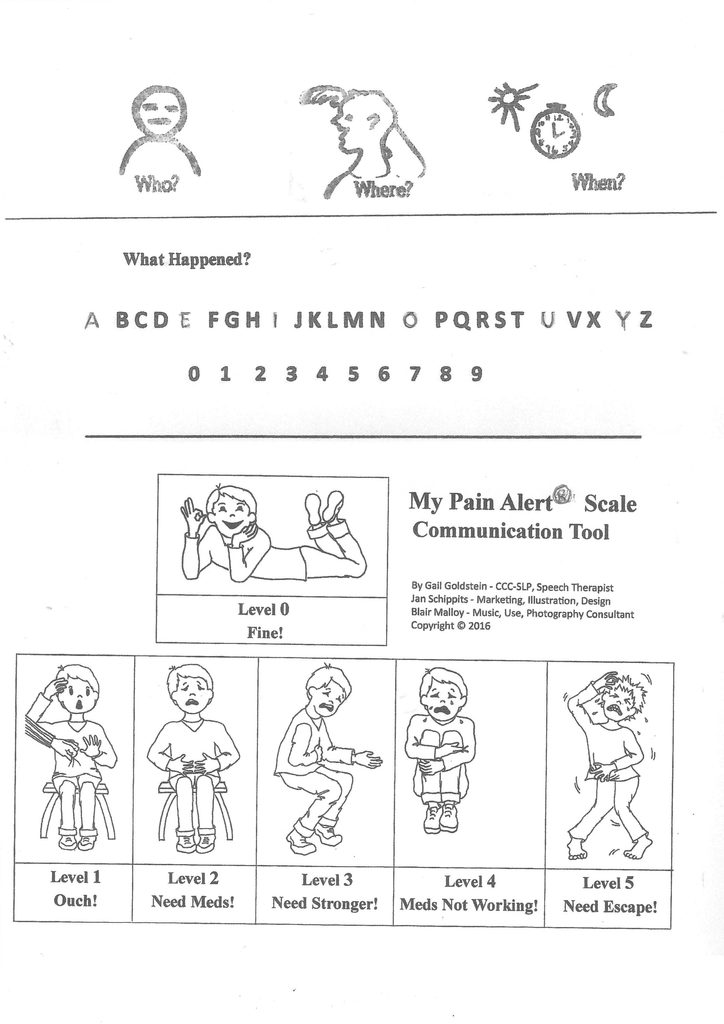
Shown is a draft of a visual tool with icons for: Who? Where? When? and print What Happened? Would having it in your transport vehicle help you provide care for the MPAS patients children, memory impaired individuals, intellectually challenged, or those whose trauma effects their communication listed above?
Please subscribe to the blog to leave your comments. First Responders willing to use it as needed can receive a trial pdf by email.
Success with MPAS or any pain scale is achieved when the Patient struggling to communicate: 1. Is “heard” and understood by the medical provider. 2. Gets care appropriate to their pain level. 3. Participates in their healthcare process, and 4. Their primary caregivers are confident the MPAS user’s needs are met.
Subscribe to follow MPAS blogs.